3 min read
TAKE A BREAK
What Is RAG in AI? Retrieval-Augmented Generation Explained
Updated: 10/19/2026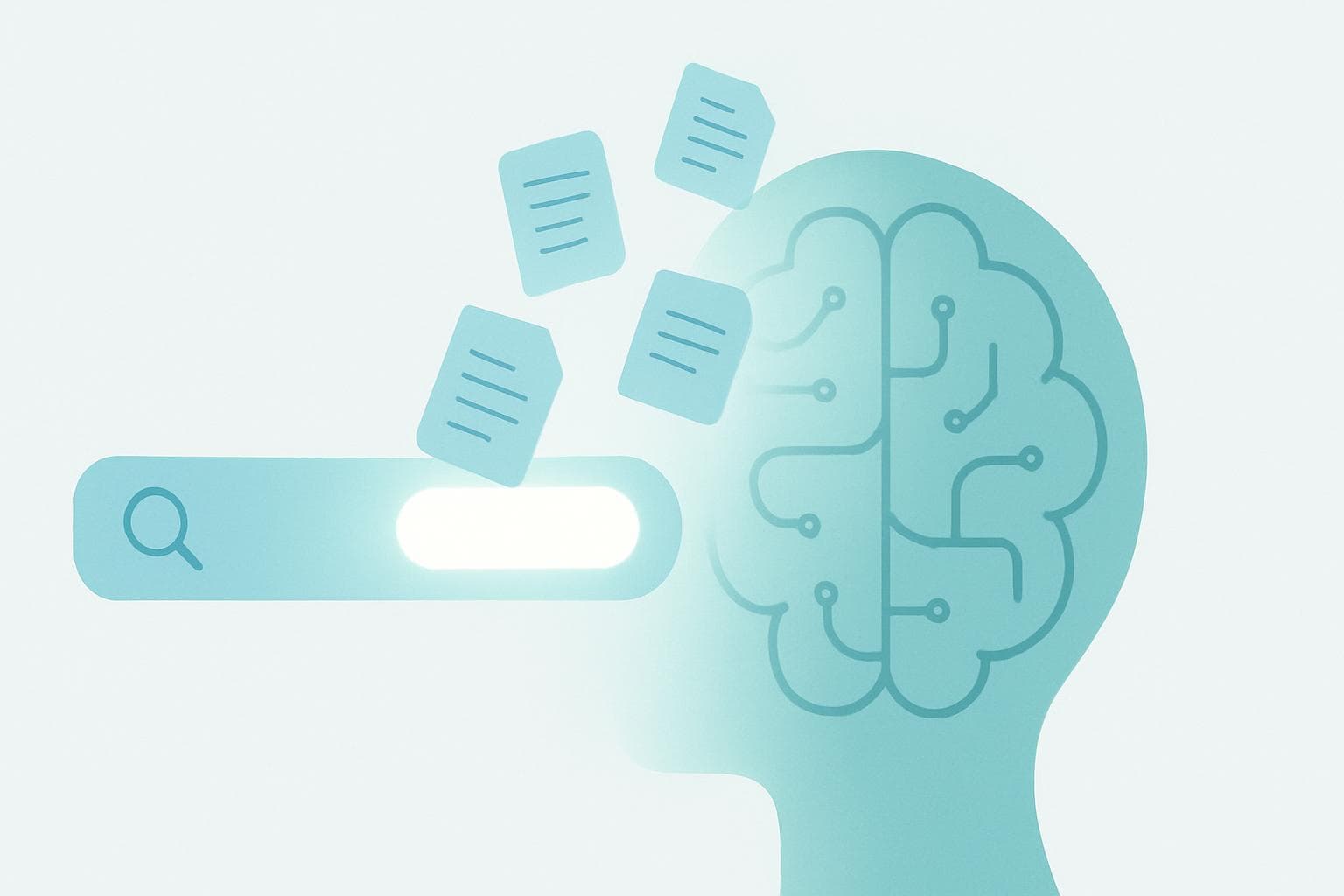
RAG stands for retrieval-augmented generation, and it's a way to help an AI model answer questions using information it can look up instead of relying only on what it memorized during training. Before the model writes a reply, the system searches a set of documents, pulls out the most relevant passages, and gives them to the model as context. The answer is built from your sources, not just from the model's general knowledge.
Put simply, RAG adds a search step before the answer. That small change is why it has become one of the most common ways companies build AI assistants, and why those assistants are only as good as the documents behind them.
What Is RAG in AI? A Plain-English Definition
IBM Research describes RAG as an AI framework for improving the quality of responses from a large language model (LLM) by grounding the model in external sources of knowledge. IBM Research In everyday terms, it's an open-book exam. The model still does the writing, but it's allowed to check the textbook first.
An LLM is the kind of model behind many chat tools. It learns patterns from a huge amount of text and predicts the most likely next words. That's powerful, but it has two built-in weaknesses: its knowledge stops at its training cutoff, and it knows nothing about your company's private policies.
Why AI Models Need a Memory Boost
Imagine you ask a chatbot about your company's refund policy. If that policy was never in the training data, the model has two options: admit it doesn't know, or guess. Guessing is where things go wrong. The model may produce a confident, fluent answer that is simply made up. Researchers call these hallucinations.
RAG tackles this with a lookup step. Instead of asking the model to remember everything, you let it read the relevant pages at the moment someone asks.
How RAG Works in Three Steps
Most guides describe RAG as three steps: search, add context, and answer. There is also a preparation step before any of that happens.
Step 1: Search
When a question comes in, the system looks for the passages most likely to help. Most modern setups convert text into numerical representations called embeddings, so the search can match meaning and not just exact words. A survey of RAG architectures on arXiv describes a typical system as having three modules: a query encoder, a retriever that ranks documents from a corpus, and a generator. arXiv survey of RAG architectures
Step 2: Add Context
The retrieved passages are attached to the user's question and sent to the model together. Wikipedia notes that this approach has also been called prompt stuffing, because it adds relevant context to the user's input. Wikipedia
Step 3: Answer
The model writes its reply using the question and the passages it was given. A well-built system tells the model to stick to that context and often shows the user which sources were used.
The Prep Work: Indexing
Before any of this runs, your documents need to be ready. They're split into smaller chunks, converted into a searchable form, and stored in an index. In the original 2020 design, that index was a dense vector index built from Wikipedia text. If the index is messy, everything downstream suffers.
A Support Chatbot, Traced Step by Step
Here's a worked example. Lumen Audio is a fictional headphone company, and its support chatbot uses RAG. A customer types:
“I bought the AirPulse 2 three weeks ago and opened the box. Can I still return it?”
Step one, search. The system finds two passages in the index:
| Document | Date | What it says |
|---|---|---|
| Returns policy | 2025 | 30 days to return; opened items accepted if unused and in original packaging |
| Store FAQ | 2025 | Refunds go to the original payment method, usually within 5 to 7 business days |
The 2022 returns policy, which allowed only 14 days and no opened items, is not in the index. The team retired it when the new policy launched, so it never reaches the model.
Step two, add context. The system sends the question and these two passages to the model.
Step three, answer. The model replies:
Yes. You can return the AirPulse 2 within 30 days of purchase. Opened items are accepted as long as they're unused and in their original packaging. Refunds go to your original payment method, usually within 5 to 7 business days.
Notice what happened. The answer comes from the current policy, and the bot can point to where it came from. The same pipeline works for any product, as long as the right documents are indexed.
The Big Catch: The Bot Is Only as Good as Its Documents
This is the most important idea for anyone building or buying a RAG system. A RAG system can only retrieve what is indexed. If the index has gaps, outdated files, or conflicting versions, the answers reflect that, and the model usually can't tell the difference.
Take the same Lumen Audio bot and a different question: “What's the warranty on the AirPulse 2?” Suppose the index holds three manuals: last year's AirPulse 2 manual, a limited-edition AirPulse 2 Midnight manual, and this year's updated manual. Retrieval may pull passages from all three. The model then blends them into one smooth answer that sounds right but mixes terms from different products.
The model did exactly what it was asked to do: read what it was given. The problem is the library. Retrieval doesn't automatically know which document is newest or which product a passage belongs to.
Retrieval can also miss a relevant passage entirely if documents were split poorly or customers word their questions very differently from the text. That's why testing matters as much as building.
A Quick Checklist Before You Launch
Before you point a chatbot at your documents, walk through this list:
- Remove duplicates so the same policy doesn't appear in three slightly different versions.
- Retire old versions, or move them out of the index entirely.
- Date-stamp every document and make the date visible to the model.
- Name an owner for each document set, with a review schedule.
- Test with real customer questions, and check which passages came back, not just whether the answer sounded good.
Where RAG Came From
The term comes from a 2020 paper by Patrick Lewis and colleagues, published on arXiv as 2005.11401. The paper's record on Semantic Scholar reports that RAG models produced more specific, diverse, and factual language than a baseline that relied only on knowledge stored in its weights.
The design has two kinds of memory. The parametric memory is what the model learned and stores in its weights. The non-parametric memory is the retrieval index it can search. NVIDIA notes that the paper's authors described RAG as a general-purpose fine-tuning recipe, meaning it can be paired with nearly any LLM and nearly any external resource. NVIDIA's explainer on RAG
RAG vs. Fine-Tuning: Which One Do You Need?
People often compare RAG with fine-tuning, and the core difference is simple. Fine-tuning changes the model itself by training it further on examples. RAG leaves the model alone and changes what it reads.
That makes RAG a good fit when facts change often, such as prices, policies, or product specs, because you update a document rather than retrain a model. Fine-tuning is more useful when you want a particular tone, output format, or specialized behavior. Many teams use both, and the right choice depends on what's actually going wrong.
Does RAG Stop Hallucinations?
It can reduce them, but it doesn't eliminate them. Giving the model relevant passages makes it more likely to stay on topic. Still, the model can misread a passage, ignore it, or combine conflicting sources. Some systems reduce this risk by showing citations, so users can check the source themselves.
Do You Need a Vector Database?
Not always. The original design used a dense vector index, and many production systems rely on vector search because it matches meaning well. For a small library of documents, though, simpler keyword search can be a sensible starting point. At 3minread, we'd start with the documents first and the tooling second.
Frequently Asked Questions
What does RAG stand for in AI?
RAG stands for retrieval-augmented generation. It means an AI model retrieves relevant information from a set of documents and uses it to generate its answer.
How does RAG work step by step?
The system searches an index for passages related to the question, adds those passages to the prompt, and asks the model to write an answer based on them. Preparing the documents in advance is what makes the search possible.
Is RAG the same as fine-tuning?
No. Fine-tuning changes the model by training it further. RAG keeps the model the same and supplies it with documents at the moment a question is asked.
Does RAG stop AI hallucinations?
It can reduce them by grounding answers in retrieved text, but it doesn't guarantee accuracy. Outdated or conflicting documents, or passages the model misreads, can still produce wrong answers.
What are the main limitations of RAG?
The biggest one is document quality, because a RAG system can only retrieve what is indexed. Other limits include missed passages when retrieval grabs the wrong chunk, and the model sometimes ignoring or blending the context it receives.
The Takeaway
RAG is a practical way to make AI answers more grounded, because the model searches before it responds. The concept is simple, but the results depend on your sources. Keep the index current, retire old versions, and test with real questions. A RAG bot is only as reliable as the documents it can read.